
E.W. Kemble: Friend or Foe?
- Feb 23, 2018
- 6 min read
Mark Twain’s writing claims an accurate portrayal of the Southern black through Jim, but Edward Kemble’s drawings create a minstrel-like caricature that is a far cry from reality. A holistic reflection on Kemble’s portfolio exposes his complete disregard for context or circumstance in his work when illustrating American novels. In Adventures of Huckleberry Finn, Kemble’s cartoonish characterization of Jim reaches its extremities in drawings such as “Jim,” “Jim and the Ghost,” and “Jim and the Snake,” which draw inspiration from blackface minstrelsy, a popular form of entertainment in Twain’s time. With Twain and Kemble offering these two contrasting depictions of Jim, Adventures of Huckleberry Finn becomes the battlefield where honesty and the status quo have come to fight.
An interesting qualifier in Kemble’s work, described by Adam Sonstegard, is that he showed the capacity for realistic expression in his depiction of slavery outside the United States. Sonstegard explained this by highlighting the difference in (attempted) American ignorance of the atrocities of slavery compared to another instance of slavery that Americans were not responsible for, therefore allowing Americans to discuss and even condemn it. Sonstegard quotes Stephen Railton who wrote, “The fictions that Kemble illustrates that are set in the American South delight in racist caricatures, yet when he is depicting slavery somewhere else,’...Kemble ‘draws slaves with human faces instead of blackface minstrel masks, and depicts their human suffering realistically”’ (Sonstegard 502). I find this juxtaposition intriguing, the variation in Kemble’s work is a tidy parallel for American denial of the impact and consequences of slavery in the South. Consequently, well-informed readers know that Kemble was capable of serious, appropriately respectful work, which begs the question: why would he choose to forego this approach while illustrating Adventures of Huckleberry Finn?
If Twain’s humorous novel elicited the cartoonish drawings that Kemble provided, it would be logical that his work could also reflect a more serious point of view if the writing called for it. Kemble’s repertoire includes illustrations for a 1891 edition of Harriet Beecher Stowe’s Uncle Tom’s Cabin, another anti-slavery story, and the caricature qualities were still very present. I found this artistic choice curious due to the drastic difference in tone between Stowe’s writing and Twain’s, although both were fiction. Twain outlined his views through heavy use of satire, giving his story a much more whimsical quality than Stowe’s realistic and blunt imagery. I would think that the contrasting styles of these novels would inspire appropriately contrasting illustrations, but obviously Kemble did not think this was necessary. Adam Stonsegard defends Kemble’s work by claiming that the comparison between the illustrations in Stowe and Twain’s books allowed these “liberal, progressive novels [to appeal to] more conservative, even reactionary audiences” (503). I believe Sonstegard is giving Kemble far too much credit, after all, Kemble was “the ripe old age of twenty-three” and had never been to the Southern United States by the time he illustrated Adventures of Huckleberry Finn (Kemble). Even Kemble’s writing, in the personal narrative style, reflects an immature and underdeveloped sense of professionalism, the product of being pushed into the spotlight without due cause. After illustrating Twain’s novel, Kemble’s drawings of Jim gained him recognition, he said “I was established as a delineator of the South, the Negro being my specialty, and, as I have mentioned, I had never been South at all.” Kemble himself seemed surprised at the strong positive reaction to these drawings, almost as if he knew they were flimsy representations of the African American race in the United States.
In a narrative written for the Colophon quarterly magazine in 1929, Kemble described the process of finding his model and starting work on the illustrations. He desired only one model for the variety of characters, which explains some necessity for cartoonish qualities in order to differentiate male from female and adult from child. By describing drawing “this Negro Jim... from a white schoolboy, with face unblackened,” Kemble expressed the need to drastically deviate from reality, he says this style “started something in [his] artistic career.” Kemble recounted some self-aware decisions to attempt keeping the drawings realistic, like when he was creating the King he said:
For the King, Cort [his young male model] wore an old frock coat and padded his waist line with towels until he assumed the proper rotundity. Then he would mimic the sordid old reprobate and twist his boyish face into the most outlandish expressions. If I could have drawn the grimaces as they were I would have had a convulsing collection of comics, but these would not have jibed with the text, and I was forced to forego them.
Kemble may have thought he eliminated the cartoonish element of his model’s face and posture, but both the resulting drawings themselves and Twain strongly disagreed. Twain originally found the artist’s images “generally ugly” and “forbidding and repulsive” (Sonstegard 499). Twain felt that Kemble’s work did not share the impression that he wanted his verbal visual to leave on his audience. Twain believed Kemble failed to preserve the integrity of these characters that he had taken years to bring to life..
I find it counterintuitive that Kemble’s depiction of Jim, specifically, does not evolve with Huck’s idea of him. It made me wonder if Kemble understood the book or even read it at all. From “Jim and the Ghost” to “Jim Advises a Doctor,” Kemble’s drawings do not reflect the development of Huck’s perspective of his companion from inopportune, runaway side-kick to caring friend. Twain expressed his distaste for this lack of depth to Charles Webster, after the book was published, that ‘if he had to make the choice over again, he would note the “tiresome” “sameness” of the artist’s images, and “would promptly put them into the fire”’ (Sonstegard 499). Norton Kinghorn described the evolution (or lack of) of the illustrations perfectly in a later criticism:
If the change in Kemble’s pictures in the middle of the book was occasioned by Twain’s criticisms, then Twain himself, and not Kemble must bear the brunt of one of the few adverse (though minor) criticisms that can justly be leveled at the first edition of Huckleberry Finn: the progress of the illustrations runs contrary to the progress of the theme of the novel– Huck grows younger and more innocent in the illustrations, while he grows in stature and wisdom in the novel; the inhabitants of the shore become less disgusting, more beautiful, in the illustrations, while they deteriorate in the novel. One might speculate that had Pap Finn not died off early in the book he might have looked like a Baptist preacher in later illustrations. (10)
Kinghorn unabashedly expressed the opinion that Kemble’s illustrations were entirely
ineffective in conveying the subtle, but real emotional and mental development that Huck underwent through the course of the story.
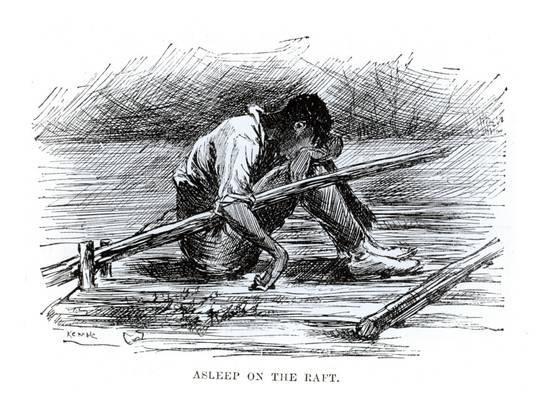
To say Kemble’s Adventures of Huckleberry Finn illustrations were completely irreverent and cartoonish would be to discredit Kemble. While the most well-known and most criticized pieces are caricatures, the quieter ones should garner some attention as well. Drawings like “Asleep on the Raft” and “We Turned in and Slept” display a serene, surprisingly poignant scene where Kemble’s famous caricature element is nowhere to be found. Jim and Huck’s faces are soft around the edges, their expressions showing nothing. Kinghorn’s criticism could lead a reader to the conclusion that these middle drawings were forced out of Kemble by Twain’s negative reaction to the first half of the book. However, I want to believe that Kemble had an inkling of this serenity inside of him, that his artistic thought process was not entirely comprised of cartoons and insensitive exaggeration.
Through reading Kemble’s narrative, while he may not have fully understood the gravity of the subject matter of Adventures of Huckleberry Finn, I think he cared for his work and truly wanted to produce something memorable, as any artist does. The struggle between author and illustrator, complex as it is, has given Huckleberry Finn the reputation and intrigue that it has gained over the years. Kemble’s work may or may not detract from the validity and fluidity of Mark Twain’s storytelling, but it has become an integral part of the reader’s experience, placing the novel in a definite period of history where depictions of black Americans were rarely, if ever, accurate and respectful. Kemble’s illustrations ground an otherwise timeless story, giving it individuality and, ironically, a sense of reality.
Works Cited
Kinghorn, Norton D. “E. W. Kemble's Misplaced Modifier: A Note on the Illustrations for ‘Huckleberry Finn.’” Mark Twain Journal, vol. 16, no. 4, June 1973, pp. 9–11., www.jstor.org/stable/41640965.
“Kemble's Illustrations for Huck Finn.” Kemble's Illustrations for Huck Finn, University of Virginia, twain.lib.virginia.edu/huckfinn/huckpix/huckpix.html.
Sonstegard, Adam. “Artistic Liberty and Slave Imagery: ‘Mark Twain's Illustrator," E. W. Kemble, Turns to Harriet Beecher Stowe.” Nineteenth-Century Literature], vol. 63, no. 4, Mar. 2009, pp. 499–542.
Kemble, E.W. “Illustrating Huckleberry Finn.” The Colophon: A Book Collectors' Quarterly, Feb. 1930.
Links to University of Virginia library student studies on Huck Finn


Comments